Program Manager


It's hard knowing what to focus on to grow in UX and product

The gap is real.
Everyone has a different opinion about what it takes to succeed in agile teamwork, and job roles.
Unlike a career like medicine, technology careers are full with convolution. Technology evolves quickly, and businesses evolve with it. Designers get involved in business. Researchers get involved in design. Product people get involved in research.
The same title at one company can carry a completely different set of duties compared to others. Work structure and operations could be completely different in each company.
The requirements seem to change based on the knowledge of the team, the environment, and the hiring managers.
This makes the gap between school and the real world worse for people getting into new careers.
Our target audience's pain points

New graduates and career changers come from different careers and backgrounds. They face many barriers to succeeding in the professional world.
- Buzzwords and jargon create misunderstandings about what skills and deliverables to practice.
- Different people have a different opinions about necessary tech career skills to hold.
- Different jobs have different daily expectations.
- Skills, tasks, tools, deliverables, and experience relate to each other in complicated ways.
- Expectations vary based on companies.
The process for end-users
- Trainees take basic training classes on agility and shared leadership.
- Teammates make decisions together as peers about the direction to take without guidance.
- The organization maintains onboarding materials to build expectations.
- The organization encourages people to build an agile mindset.
- Teams rely on handbooks and videos for basic training.
Key changes we made

- Break down the requirements for team-based problem solving.
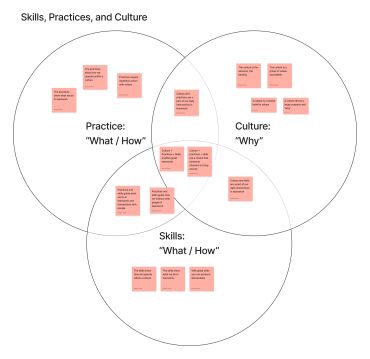
- Concretely explain skills, practices, activities, deliverables, methods, and workshops involved in team-based projects.
- Help teams understand the skills, tasks, and deliverables required to complete project milestones.
- Help trainees communicate skills they gain as they work on tasks and deliverables.
- Help trainees make informed decisions about professional development gaps.
- Help trainees tell the story about growth gained in team experience.
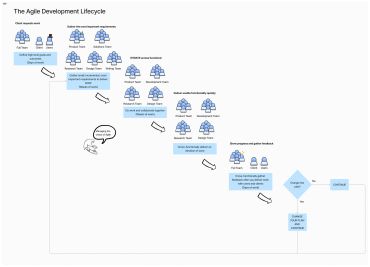
- Show the process for agile product and service development.
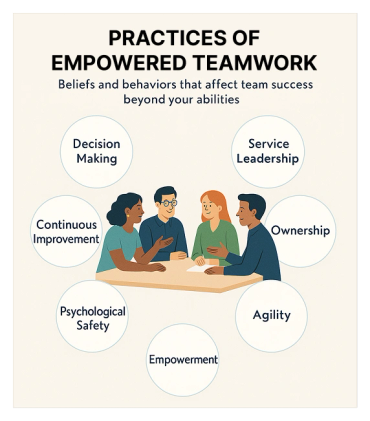
It starts with understanding the components of teamwork

Key strategies
Build Knowledge In the Moment
We needed to separate the theory from the action. We provided ways to learn things in the moment they are needed based on different scenarios of user-centered needs. This helps teams reflect on the results as they go.
Get Trainees to Relate to Content
This information is dense, and takes time to learn. To build engagement we showed how their personal goals are affected by project deliverables to help them relate. This helped increase ownership and buy-in to the work.
Chunk the Learning
We built training experiences that rely on progressive disclosure of information. This helps trainees learn a little at a time and start to see connections between concepts.
Model Behavior for Teams
People can read books, watch videos, hear experts talk, and still not be ready to perform cross-functional work. They need to see how it's done. They need to decide together. Not only do we have observation opportunities, but we have training templates that model behavior.
Visualize Examples
Providing different ways to learn the subject matter is key to success. Some people want to hear it, some want to read it, some want to talk it out, some want to do it.
How it's going so far

The Skills and Practices Framework lives in training materials in Tech Fleet. It's applied to the Agile Coaching Residency training, the user guide, team onboarding, and the team-based workshop templates.
Teams use it when they learn what it takes to ship products and services. Project coordinators use it to plan project scope. Coaches use it to .coach teams how to be agile teammates
What people say about the changes

Measuring the impact

Training Satisfaction
We received a 75% training satisfaction score. This improved over 15%. People mentioned the workshop templates helped them set expectations, and do the work well. They appreciated the guidance that coaches provided while working with teams who were unsure how to proceed in the work.
Levels of Agility
Empowered team maturity increased immensely during and after the projects. Trainees reported that the training (based on the framework) helped them succeed.
- Cross-functional teamwork levels increased 20%
- Drop out rate decreased by 5%
- Ownership levels improved 14%
- Service leadership and psychological safety levels increased around 10%
- Preparation levels increased 20%
Deliverables Completion
Because of our common language, we saw more consistent creation of teamwork deliverables. Caches coached teams to run training templates that helped them model behavior and do the work successfully for the first time. Best of all, they didn't need a mentor giving them answers; they self-organized together.
Client Satisfaction
Clients reported that their projects were delivering stronger results after we applied the Skills and Practices framework to our training templates.
What we learned through validation

- Teams expressed desires to get more subject matter guidance in the moment they are doing agile work.
- Some workshops of the framework were overwhelming to trainees who were not led through them by facilitators.
- Some still misinterpreted the components of empowered teamwork even after the framework.
- Some trainees didn't attend all of the workshops we've offered in pre-kickoff onboarding.
Future recommendations

- How might we decrease project training abandon rate?
- How might we help trainees measure their own success in skills and practices?
- How might we help trainees tell the story about their experience on teams?
- How might we increase full workshop attendance?
- How might we further reduce the gap between knowledge and readiness?