Morgan denner

Morgan dennerMorgan dennerMorgan denner

Morgan denner

Morgan dennerMorgan dennerMorgan denner
  • Home
  • About Me
  • Approach
  • Examples
    • A Language of Teamwork
    • Empowered Team Culture
    • Medical Billing Flows
  • Contact

Creating Effective Healthcare Billing Experiences

Get the Slide Deck

Product Designer

Medical billing can be complex and risky for hospitals

Medical billing involves many steps and moving parts. Businesses and hospitals must comply with standard requirements in order to receive payment. 


The teams in charge of different parts of this process carry the weight of the work. They have to move fast and accurately in order to remain in business. 


This makes it even larger of a challenge when a lot of the systems and data are spread across many platforms. 

Intended business outcomes

  1. Allow users to work more efficiently during the life cycle.
  2. Combine the experience of many current applications.
  3. De-risk barriers to successful hospital operations.
  4. Help billing specialists and managers manage tasks.
  5. Help users troubleshoot tasks in their day-to-day workflows.
  6. Identify the key opportunities for users and the business. 
  7. Provide universal consistency between apps. 
  8. Scale the product experience for future growth.

See it in action

    Project summary

    Timeline

    6 months

    Business

    The client operated a Software-As-A-Service platform with many features that manage the entire billing cycle for hospitals. The product we designed replaced existing offerings that the client had.

    Responsibilities

    Along with a cross-functional team, I was responsible for:

    1. Coordinating with clients
    2. Performing and analyzing Research
    3. Creating UI Designs
    4. Designing Customer experience 
    5. Managing project backlogs
    6. Writing and gathering requirements
    7. Performing User testing
    8. Managing project plans and timelines

    Team process

    The cross-functional team of product designers, project managers, product managers, and developers operated with a two-week Sprint cycle using the Scrum method.

    How we measured success

    Error Rate

    Time Between Steps

    Insurance Denial

    Measuring how often people made mistakes in the software.

    Insurance Denial

    Time Between Steps

    Insurance Denial

    Measuring the rate at which insurance companies denied claims.

    Time Between Steps

    Time Between Steps

    Time Between Steps

    Measuring the time it takes to finish each step of the billing lifecycle.

    Screen Time

    Support Ticket Rate

    Time Between Steps

    Measuring how long end-users take on each key page of the process.

    Support Ticket Rate

    Support Ticket Rate

    Support Ticket Rate

    Measuring how many average support tickets came in monthly.

    Time to Learn

    Support Ticket Rate

    Support Ticket Rate

    Measuring how long it takes to learn the new system on average.

    Completion Time

    Training Satisfaction

    Training Satisfaction

    Measuring how long the entire billing lifecycle takes for teams.

    Training Satisfaction

    Training Satisfaction

    Training Satisfaction

    Measuring how happy people are with the organization's training.

    User Satisfaction

    Training Satisfaction

    User Satisfaction

    Measuring how satisfied teams who use the software feel.

    Our target audience's pain points

    Medical billing teams face a lot of barriers to their own success during the work day:

    1. The software has a lot of features and ways of doing things because it's used by a lot of different types of clientele.
    2. It takes a long time to master medical billing concepts and workflows in the tools.
    3. Users often need to open different screens, apps, and tabs to perform tasks today.
    4. Some billing ore pre-billing specialists need to troubleshoot over 80 case records a day to keep up with their quota; as such, they have ways of quickly deciding which work to prioritize and need to move quickly.
    5. When troubleshooting medical claim and case errors, users often hunt to find the issue.
    6. When using the previous offerings, the system helps users assist in fixing errors and users rely heavily on it.
    7. Most teams we spoke with have their managers assign tasks through spreadsheets and emails today.
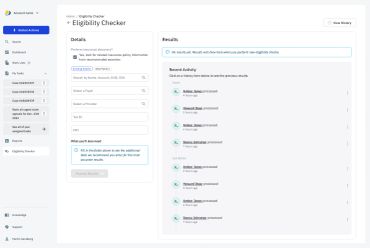
    8. When checking insurance eligibility, it's hard to easily scan through the benefits responses from insurance payers.
    9. Users have a hard time accessing previous eligibility checks in certain cases, and sometimes lose the eligibility checks in progress if they take too long to finish.
    10. There are opportunities to bring certain pieces of data to top focus for users to help them complete their work.

    The process for end-users

    1. Billing specialists switch between different apps.
    2. There are a lot of tasks and logic checks.
    3. The Eligibility and claims process can vary depending on the organization.
    4. Volume and speed are prioritized day-to-day.
    5. Data comes from many sources and employees check various places.
    6. Billing specialists prioritize “easy” cases that are not “priority”.

    Key changes we made

    1. Build progressive disclosure for workflows.
    2. Enable quick action in the system.
    3. Keep users on a single page during workflows.
    4. Modernize the experience while increasing usability.
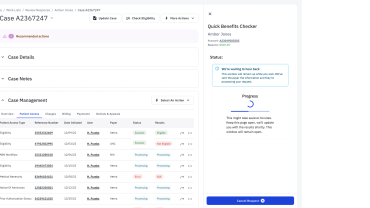
    5. Provide system feedback to help users troubleshoot.
    6. Provide ways to manage and assign workflows.
    7. Recommend key actions based on risky data.
    8. Unify important data into a single source.

    Key strategies

    Chunk the process

    Billing teams handle specific parts of the lifecycle, and need to focus on specific parts. We designed the experience to focus on chunks of information at a given time based on the workflows we learned about. This helps people quickly complete the step they own.

    Allow users to control the logic

    A lot of the client's customers had unique operations for billing. The system needed to be modular and able to be flexibly controlled by hospitals who have different needs. We built this architecture from the ground up.

    Reduce learning curve

    We learned it takes months, if not years, to fully learn medical billing systems today. The steep learning curve comes from medical billing jargon and confusing structures of information. We designed an experience that breaks things down for people at every step. This helps both inexperienced and experienced take les time to learn the system.

    Show what the system is doing

    The complex systems behind the scenes may be doing things that users don't know about. We learned a lot of errors happen in the old systems when billing teams are trying to troubleshoot errors. The experience we designed shows visual feedback about what's going on behind the scenes. This helps teams make decisions faster, and make less errors.

    Stay on the same page

    The billing systems that teams use today are open across many different browser tabs. People switch between websites and apps to finish their work. This adds a lot of time to workflows. We designed an experience that keeps users on the same page when adding, editing, or removing data in the workflow. We measured a huge decrease in time to task completion because of this.
    How it's going so far

    The results were mixed. We noticed some resistance to change. 


    Through usability testing task analysis, we found that tasks were sped up. But people reported things differently. Some teams using the old product appreciated the shift in where the information was displayed. Others reported that the new tools will take more time than it's worth. 


    We decided to propose we do more live testing with customers of the product to explore the resistance further. 

    Measuring impact

    Error Rate

    Time Between Steps

    Insurance Denials

    We worked with client leadership to start tracking the error rates monthly, broken down by section, within the database. This allows teams to focus efforts fixing high impact sections of the software.

    Insurance Denials

    Time Between Steps

    Insurance Denials

    We worked with client leadership to start tracking the denial rates within the database. We discussed reducing the denials by 10% per quarter, by improving data quality. 

    Time Between Steps

    Time Between Steps

    Time Between Steps

    Through analytics, the team set up measurements to track the time it takes to complete each step of billing lifecycles. We setup reports that allow leadership to see the changes made over time.

    Screen Time

    Support Ticket Rate

    Time Between Steps

    Screen time is important when dealing with medical billing workflows because the activity must happen at volume. The people doing medical billing need to finish over 100 cases per day in their tep of the process. The longer people stay on screen, the more convoluted their workflow is. we measured this to try and calculate the ideal baseline for each step of the process.

    Support Ticket Rate

    Support Ticket Rate

    Support Ticket Rate

    We helped the team track the number of monthly support tickets to track changes in issues over time. Over the course of 3 months, support tickets dropped 14% with the changes we made. 

    Time to Learn

    Support Ticket Rate

    Support Ticket Rate

    The time to learn the software is complicated for this product. Medical billing takes a lot of knowledge, skills, and practice. We helped the team determine a baseline to learn the system through the trainines they offered clients.

    Completion Time

    User Satisfaction

    User Satisfaction

    Completion time must be reduced if teams will be able to get through over 100 cases per day in each step. Taking the combination of time to complete and screen time is important for the overall metric of time to complete. We helped the team set up and track this metric for their clients to be able to report to leadership. 

    User Satisfaction

    User Satisfaction

    User Satisfaction

    We added Net Promoter Score to the company's quarterly survey so that the team could tack changes in overall likelihood to recommend the product to others. 

    What we learned while testing the changes

    1. Keeping the user on screen increased satisfaction on  the product. 
    2. People are resistant to change in their workflow even if it's currently complex.
    3. Data must be available and accurate for teams to make the most use out of the new features.
    4. People who were open to change reported that this experience would save them time.
    5. We effectively centralized data across business functions for multiple departments to work more efficiently. 

    Future recommendations

    1. How might we overcome resistance to change in the software?
    2. How might we evaluate specific steps in the medical billing workflow more? 
    3. How might we improve accuracy and readiness of data across teams?
    4. How might we measure the effectiveness of changes after the product is launched at market?
    5. How might we streamline user-friendliness of tools within the product?

      Copyright © 2025 Morgan Denner - All Rights Reserved.

      • Home
      • About Me
      • Approach
      • A Language of Teamwork
      • Empowered Team Culture
      • Medical Billing Flows
      • Contact

      Powered by user-centered design

      This website uses cookies.

      We use cookies to analyze website traffic and optimize your website experience. By accepting our use of cookies, your data will be aggregated with all other user data.

      Accept