Program Manager


No one can ever truly prepare for teamwork

You have to jump in. It's not enough to learn about empowered teamwork in a classroom.
People have to train in different ways than they were taught in school.
Empowered teams practice removing fear and perfection. It requires collective decision making and practice.
One person can't do it alone

Everyone needs to share the same mindset and behaviors:
- Interacting with the team to define process.
- Delivering working results early and often.
- Collaborating with clients and end-users.
- Responding to change when it makes sense.
People bring preconceptions about what it means. They may be resistant to change the ways they think and work.
Our target audience's pain points

New graduates and career changers come from different careers and backgrounds. They face many barriers to succeeding in the professional world.
- Schools teach basic hard skills.
- Schools teach waterfall mindsets.
- Companies expect prior on-the-job experience
- Teamwork requires mindset and behavior changes.
- Company job expectations differ.
- Advice varies about what it takes to succeed.
- Trainees are self-guided about properly doing cross-functional teamwork.
The process for end-users
- Trainees take basic training classes on agility and shared leadership.
- The organization maintains onboarding materials to build expectations.
- Trainees work together as peers without experts.
- Project coordinators interview trainees.
- Teams rely on handbooks and videos for basic training.
Key changes we made
- Five weeks of coaching on teams.
- Overcoming resistance to change.
- Team-based reflections of learning.
- Behavior modeling in teamwork.
- Reward those who built mindsets.
- Workshop templates for teams.
- Continuous improvement training.
- Measuring levels of team maturity.
Start with the "why"

Key strategies
Build Ownership
Teammates need to feel they have control over their own future. They have to feel that what to do and say matters to the shared outcome.
Chunk the Learning
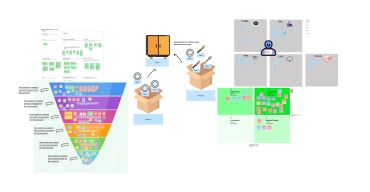
We built training experiences that rely on progressive disclosure of information. This helps trainees learn a little at a time and start to see connections between concepts.
Discuss Resistance to Change
Teams must face their own barriers, like doing something completely different from how they have been trained. In moments of stress, teams resort back to what they think is comfortable: waterfall models. We openly discuss the shift in the mindset while it was being formed through team discussions.
Model Behavior for Teams
People can read books, watch videos, hear experts talk, and still not be ready to perform cross-functional work. They need to see how it's done. They need to decide together. Not only do we have observation opportunities, but we have training templates that model behavior.
Prioritize Human Connection
Teammates must build trust with each other and see that they are not in competition. We fostered "human time" where people got together to discuss life. This helped teams open up and see others as peers.
How it's going so far

In just three months of live coaching, training teams have transformed.
Teammates work together to produce shared outcomes.
Clients, teammates, and coaches are all working in unison across functions.
Teams are progressively making the connections they need to change their mindset and behavior.
What people say about the changes

Measuring the impact

Levels of Agility
Empowered team maturity increased immensely during and after the projects.
- Cross-functional teamwork levels increased 20%
- Ownership levels improved 14%
- Service leadership and psychological safety levels increased around 10%
- Preparation levels increased 20%
Training Satisfaction
We received a 75% training satisfaction score. This improved over 15%. People mentioned the workshop templates helped them set expectations, and do the work well. They appreciated the guidance that coaches provided while working with teams who were unsure how to proceed in the work.
Deliverables Completion
Because of our common language framework for skills, tasks, deliverables, and project milestones, we saw more consistent creation of teamwork deliverables. Caches coached teams to run training templates that helped them model behavior and do the work successfully for the first time. Best of all, they didn't need a mentor giving them answers; they self-organized together.
What we learned through validation

- Teams expressed desires to get subject matter expertise in the moments they are doing agile work.
- People struggled to work through uncertainty with clients.
- Some still misinterpreted the components of empowered teamwork even after training.
- Co-leads dictated to apprentices instead of offering shared leadership and flat hierarchy structures.
- Behavior and mindset shifts take time, and people need to hear that they won't improve their agility quickly.
- Some trainees didn't attend all of the workshops we've offered in pre-kickoff onboarding.
Future recommendations

- How might we decrease project training abandon rate?
- How might we increase full workshop attendance?
- How might we further reduce the gap between knowledge and readiness?
- How might we generate buy-in for team practices to those who haven’t shifted mindsets yet?
- How might we improve teammate ownership on an individual level?
- How might we accurately represent inclusion, learning, contribution, and challenger safety levels?